New Transparent Solar Cell …
The Applications Are ENDLESS !
Researchers at Michigan State University have created a fully transparent solar concentrator, which could turn any window or sheet of glass (like your smartphone’s screen) into a photovoltaic solar cell. Unlike other “transparent” solar cells that we’ve reported on in the past, this one really is transparent, as you can see in the photos throughout this story. According to Richard Lunt, who led the research, the team are confident that the transparent solar panels can be efficiently deployed in a wide range of settings, from “tall buildings with lots of windows or any kind of mobile device that demands high aesthetic quality like a phone or e-reader.”
Scientifically, a transparent solar panel is something of an oxymoron. Solar cells, specifically the photovoltaic kind, make energy by absorbing photons (sunlight) and converting them into electrons (electricity). If a material is transparent, however, by definition it means that all of the light passes through the medium to strike the back of your eye. This is why previous transparent solar cells have actually only been partially transparent — and, to add insult to injury, they usually they cast a colorful shadow too.
A fully transparent solar cell that could make every window and screen a power source
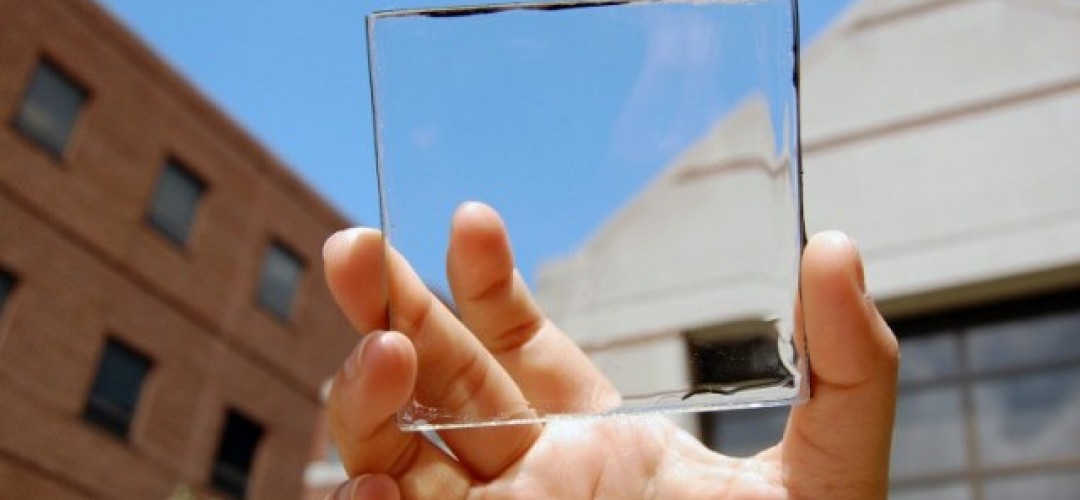
To get around this limitation, the Michigan State researchers use a slightly different technique for gathering sunlight. Instead of trying to create a transparent photovoltaic cell (which is nigh impossible), they use a transparent luminescent solar concentrator (TLSC). The TLSC consists of organic salts that absorb specific non-visible wavelengths of ultraviolet and infrared light, which they then luminesce (glow) as another wavelength of infrared light (also non-visible). This emitted infrared light is guided to the edge of plastic, where thin strips of conventional photovoltaic solar cell convert it into electricity. [Research paper: DOI: 10.1002/adom.201400103– “Near-Infrared Harvesting Transparent Luminescent Solar Concentrators”]
The Key Word Here is …. TRANSPARENT
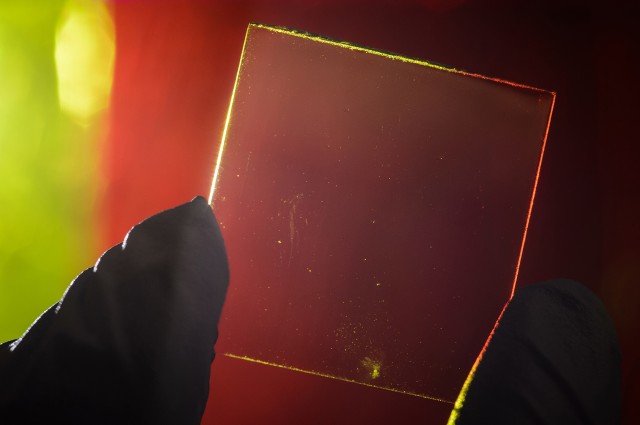
According to Richard Lunt of MSU’s College of Engineering, the key word is “transparent.”
The solar harvesting system uses small organic molecules developed by Lunt and his team to absorb specific nonvisible wavelengths of sunlight.
“We can tune these materials to pick up just the ultraviolet and the near infrared wavelengths that then ‘glow’ at another wavelength in the infrared,” he said.
The “glowing” infrared light is guided to the edge of the plastic where it is converted to electricity by thin strips of photovoltaic solar cells.
“Because the materials do not absorb or emit light in the visible spectrum, they look exceptionally transparent to the human eye,” Lunt said.
One of the benefits of this new development is its flexibility. While the technology is at an early stage, it has the potential to be scaled to commercial or industrial applications with an affordable cost.
“It opens a lot of area to deploy solar energy in a non-intrusive way,” Lunt said. “It can be used on tall buildings with lots of windows or any kind of mobile device that demands high aesthetic quality like a phone or e-reader. Ultimately we want to make solar harvesting surfaces that you do not even know are there.”
Other members of the research team include Yimu Zhao, an MSU doctoral student in chemical engineering and materials science; Benjamin Levine, assistant professor of chemistry; and Garrett Meek, doctoral student in chemistry.\
These researchers have formed a company … Ubiquitous Energy …
to bring this tehnology to market.
There have already been other tech groups in Silicon valley that are also investing massive resources, in the race to bring this technology to market !
One example is Brite Solar … http://www.britesolar.com